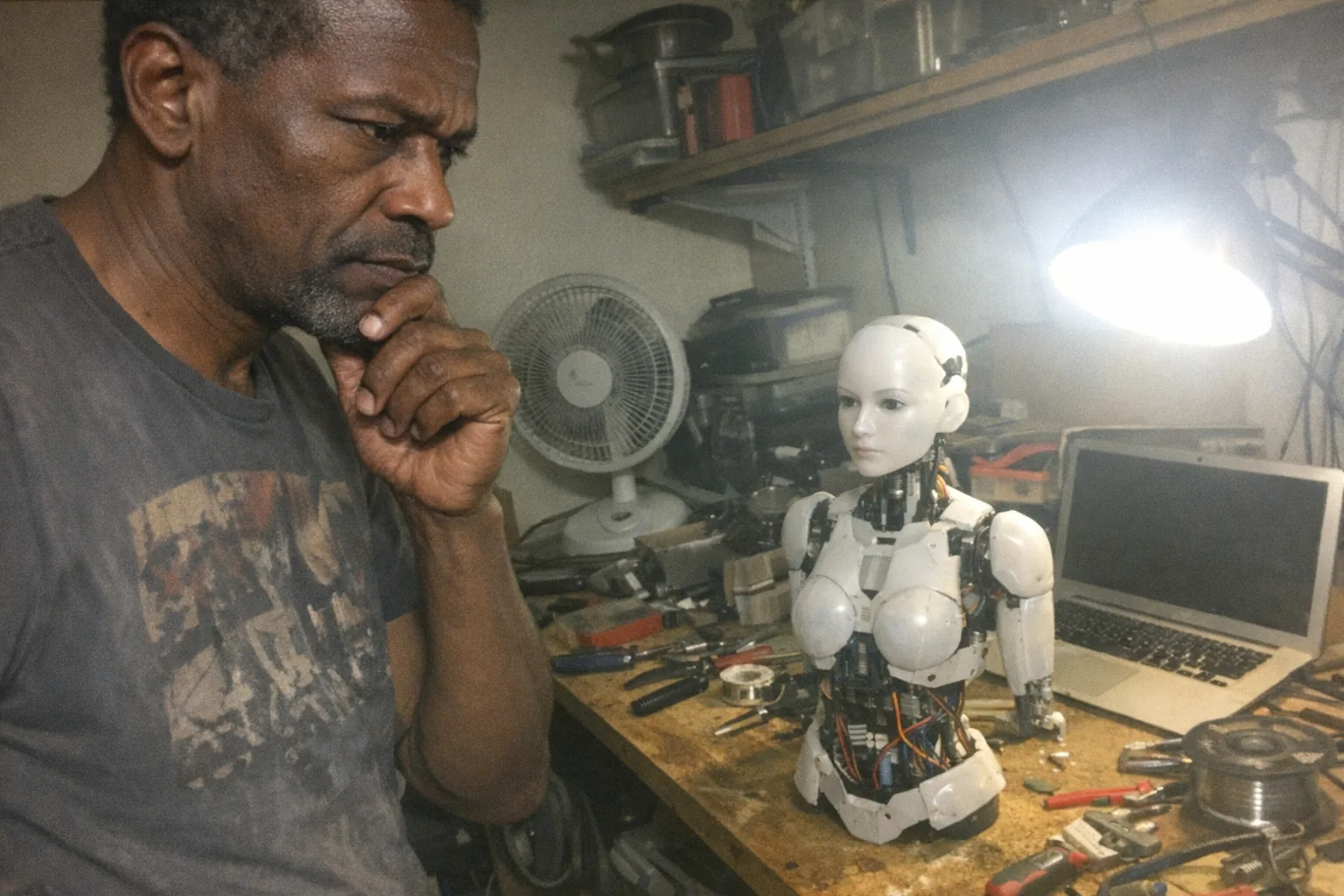
What are the qualities of a robot?
A “robot” isn’t simply any high-tech gadget or any system that uses AI. In practical terms, a robot is a physical system that can sense its environment, decide what to do, and act on the world—often repeatedly and with some level of independence.
Below are the most important qualities that show up again and again in real-world robots, from factory arms to home devices and consumer “interactive” products.
1) Embodiment: a robot has a physical presence
Robots are typically embodied—they occupy space, have a form factor, and must deal with real-world constraints like friction, weight, temperature, and wear.
- A chatbot can be intelligent, but it isn’t a robot.
- A drone, a warehouse picker arm, or a moving home device is a robot because it physically operates in the world.
Why it matters: Embodiment forces design tradeoffs (strength vs. weight, durability vs. cost, quietness vs. power) that don’t exist in purely digital AI.
2) Sensing: a robot can detect what’s happening
A robot needs inputs—ways to observe itself and/or its environment.
Common sensing qualities include: - Proprioception (self-sensing): position, speed, torque, internal temperature, battery status - External sensing: cameras, microphones, depth sensors, touch/pressure sensors, proximity sensors
Key quality: Sensing isn’t just “having a sensor.” It’s about reliable measurement in messy conditions (low light, clutter, noisy signals) and knowing when readings are uncertain.
3) Actuation: a robot can do work
Robots don’t just “know”—they change the world through actuation.
Examples: - Motors, servos, linear actuators - Pneumatics/hydraulics - Speakers, haptics, lighting (for feedback)
Key quality: Good actuation is controlled, repeatable, and safe—with predictable behavior across many cycles.
4) Control: the robot can turn intent into motion
Control is the bridge between “what I want” and “what I do.” It includes: - Feedback loops (correcting motion as conditions change) - Calibration (aligning what the robot thinks is happening with reality) - Fault handling (what it does when something goes wrong)
Key quality: A robot should fail gracefully—slowing down, stopping, or alerting a user instead of forcing motion.
5) Autonomy: the ability to operate with limited supervision
Autonomy is a spectrum: - Teleoperated: a human is driving every action - Assisted: the robot helps, but the human directs - Semi-autonomous: the robot performs tasks but asks for help when uncertain - Autonomous: the robot plans and executes tasks independently in its operating domain
Key quality: Useful autonomy is less about “being smart” and more about being dependable within clear boundaries.
6) Intelligence (optional, but increasingly common)
Not all robots use modern AI. Many are “classical” robots following programmed steps. But as robots become more interactive, intelligence becomes more relevant:
- Perception: recognizing objects/events from sensor data
- Planning: choosing actions to reach a goal
- Learning: improving performance over time
- Dialogue/interaction: understanding user intent and responding naturally
Key quality: The best robotic intelligence is practical: it knows what it can’t do, and it communicates uncertainty clearly.
7) Safety: physical systems must be safe by design
Robots can apply force, so safety is a defining quality—not an afterthought.
Safety qualities include: - Force/torque limiting - Emergency stop behaviors - Soft or compliant materials in contact areas - Collision detection and conservative motion planning
Key quality: A safe robot is predictable, transparent, and conservative when signals are ambiguous.
8) Robustness and reliability: it works in real life, not just demos
A robot that only works in perfect conditions isn’t a great robot.
Reliability qualities: - Tolerates dust, minor misalignment, and everyday handling - Holds calibration over time - Has diagnostics (knows when it needs service)
Key quality: A “quality robot” is judged by uptime, consistency, and maintenance needs more than by flashy features.
9) Human-centered design: robots should fit people, not the other way around
Especially in homes and personal settings, a robot’s success depends on human factors:
- Clear controls and feedback
- Respect for boundaries (physical and social)
- Quiet operation and non-threatening motion
- Easy cleaning and maintenance
Key quality: The robot should feel understandable—users should be able to form accurate expectations quickly.
10) Privacy and security: sensors create responsibility
If a robot collects data (video, audio, biometrics, usage patterns), it must protect it.
Security and privacy qualities: - Minimal data collection by default - Strong device security (updates, encryption, access controls) - Transparent user controls
Key quality: Trust is a feature—without it, “smart” robots become stressful to use.
A quick way to tell if something is “robot-like”
Ask these three questions: 1. Does it sense? (detects state of self/environment) 2. Does it decide? (control logic or AI chooses actions) 3. Does it act? (changes the physical world)
If the answer is yes to all three, it’s very likely a robot (or at least a robotic system).
How these qualities show up in modern interactive consumer devices
In consumer “interactive” devices—especially ones designed for personalized experiences—robotic qualities often show up as tight sensing + controlled actuation + safety limits.
For example, Orifice.ai offers a sex robot / interactive adult toy for $669.90 that includes interactive penetration depth detection. From a robotics perspective, depth detection is a sensing-and-feedback feature: it helps the device respond consistently and safely based on real-time measurements, rather than running “blind.”
If you’re evaluating any interactive device in this category, look for the same robot fundamentals discussed above: sensing accuracy, controlled actuation, clear safety behavior, and good user-centered design.
Bottom line
The qualities of a robot aren’t about looking humanoid or sounding intelligent. The essentials are:
- Embodiment (physical presence)
- Sensing (measuring the world)
- Actuation (doing work)
- Control (turning goals into safe motion)
- Autonomy (operating with limited supervision)
- Reliability + safety + human-centered design (what makes it usable)
When you start judging robots by these fundamentals, it becomes much easier to compare everything from industrial machines to home companions—and to spot which products are genuinely “robotic” versus merely “smart.”