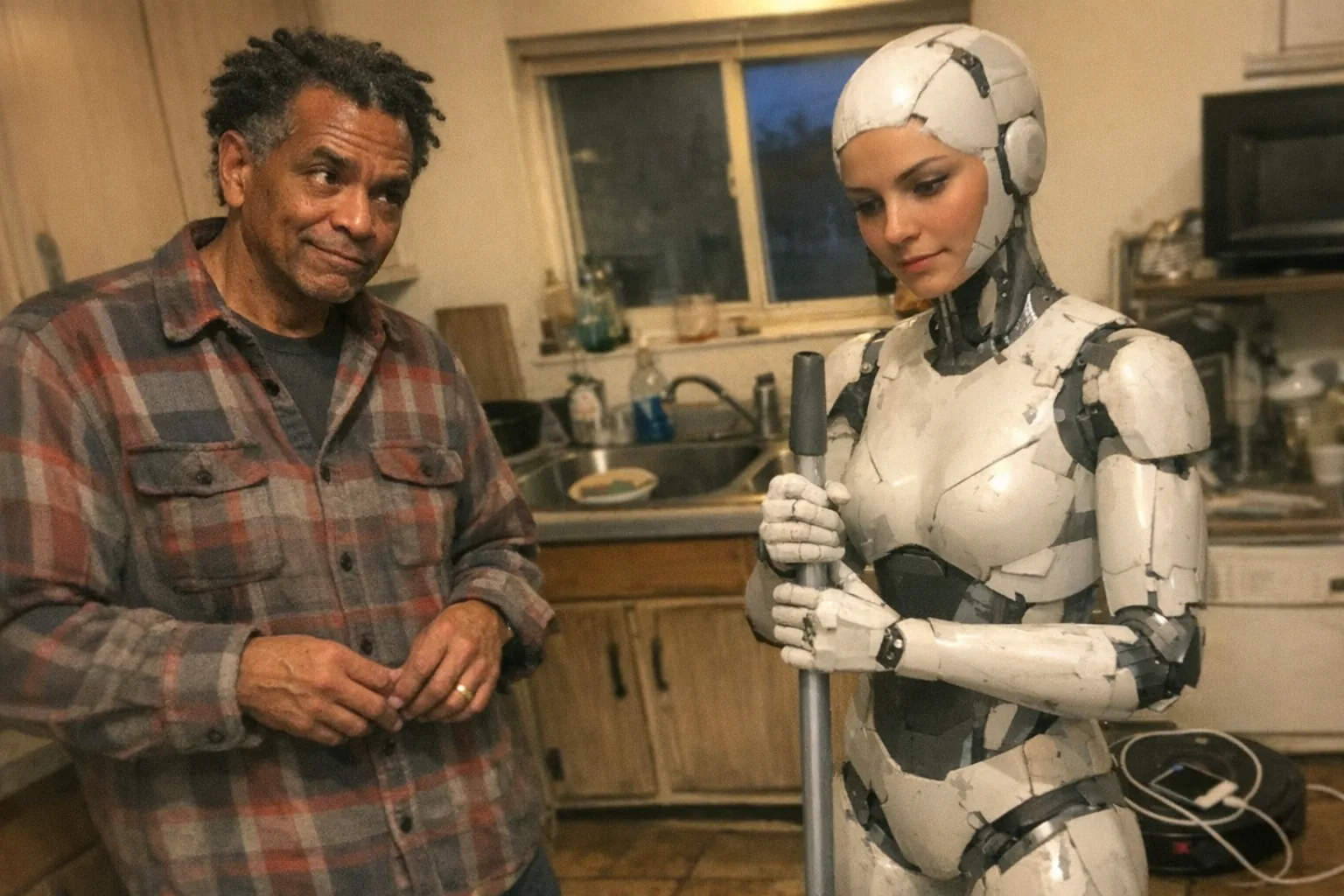
How close are we to robot maids?
If by “robot maid” you mean a machine that can reliably clean, tidy, and run a home with minimal supervision, we’re not very close—at least not in the “buy one at Best Buy and forget about chores” sense.
But if you mean robots that handle meaningful slices of household work, then the answer is: we’re already living in the early robot-maid era, just in a fragmented, unglamorous way.
Below is the real 2025 picture: what robots can do today, what’s coming next, and why the leap from “vacuum bot” to “maid bot” is so much bigger than it looks.
1) We already have “robot maids”… they just don’t look like maids
Modern homes are full of task-specific automation:
- Floor care: robot vacuums and mops are genuinely useful, but they still struggle with cords, clutter, thresholds, and “mystery messes.”
- Dishwashing and laundry: not robots in the humanoid sense, but they’re major labor reducers.
- Smart home routines: lights, thermostats, security cameras, and voice assistants reduce micro-tasks.
This is the first key reality check: the most successful home robots are the ones that do one job extremely well.
2) The “robot maid” everyone imagines is really two hard problems
When people picture a robot maid, they’re imagining a single system that combines:
A) Mobility
It must navigate a messy, changing environment—pets, kids, guests, tight hallways, uneven lighting.
B) Manipulation
It must handle the world the way humans do:
- pick up socks
- open cabinets
- move fragile items safely
- fold fabric
- identify what’s trash vs. what’s important
Manipulation is the killer feature—and it’s where most “almost there” demos break down.
3) Humanoid robots are improving fast… but the home is still the hardest “factory”
The big recent shift is that humanoid robotics is no longer purely a research toy. Companies are aiming for real deployments, first in controlled environments (warehouses/factories), and increasingly in homes.
- 1X said it plans early tests of its humanoid robot in “a few hundred to a few thousand” homes by the end of 2025, while acknowledging heavy reliance on teleoperators (humans remotely assisting) during this stage.
- Figure raised over $1B in a round valuing it around $39B (reported Sept 16, 2025), with plans to scale humanoids into homes and commercial operations.
And you’re also seeing “home chore” style demonstrations circulating widely (vacuuming, taking out trash, etc.), which—whether perfectly autonomous or not—signal where the industry is headed.
Separately, big consumer-tech players keep probing the “robot in your house” concept:
- Amazon has continued to position Astro as a home robot experiment while discontinuing its business security variant to refocus efforts. (1)
Translation: humanoids are advancing, but many “home-ready” robots still need human backup, careful staging, and lots of iteration.
4) Why robot maids aren’t here yet (the bottlenecks that matter)
Reliability beats capability
A robot that succeeds 90% of the time is still a problem in a home. Humans don’t want to supervise a machine that:
- drops a glass once a month
- mis-sorts valuables into trash
- gets stuck under a chair
In homes, failure is expensive, dangerous, and emotionally exhausting.
Edge cases are infinite
Homes have:
- different layouts
- different tools
- different standards of “clean”
- different rules (“don’t touch that shelf”)
A factory can standardize; a home is chaos.
Safety is not optional
A useful maid robot needs strength (to lift, push, carry). Strength plus autonomy raises hard questions:
- safe joint torque limits
- fall detection
- child/pet interactions
- what happens when sensors fail
Maintenance and uptime
Real robots need:
- cleaning (ironic but true)
- charging
- repairs
- part replacements
- software updates
A “maid” that creates a new maintenance hobby won’t feel like progress.
Cost (and the hidden cost of support)
Even if hardware costs fall, the service layer is expensive:
- remote monitoring/teleoperation
- customer support
- insurance and liability
- in-home installation
That’s why early “robot maids” may arrive as subscription services (robot + support) before they arrive as simple appliances.
5) So… how close are we, really? A practical timeline
Here’s a grounded way to think about it:
Already here: “Partial maids” (single-purpose robots)
- floor cleaning
- home patrol/monitoring
- limited delivery/companion bots
Near term (1–3 years): Better chore robots, still narrow
Expect improvement in:
- obstacle handling
- mapping
- object detection
- “do this routine every night” reliability
But mostly in single-purpose machines.
Mid term (3–7 years): Early true “maid-like” helpers—for early adopters
This is where we may see:
- mobile manipulators that can do a small set of chores (pick up clutter, load/unload simple items)
- significant teleoperation or “call for help” fallback
- strong privacy controls becoming a selling point (because home robots are basically rolling sensor arrays)
1X’s 2025 home-testing plan is a good signal that this phase is starting, even if it’s not consumer-ready yet.
Longer term (7–15 years): The first broadly useful “robot maid” products
This is the earliest window where you could plausibly see a mainstream product that:
- does multiple chores end-to-end
- works in most homes
- needs minimal babysitting
Even then, it may still be “good enough” rather than truly human-level.
6) The surprising takeaway: intimacy tech is often “ahead” of home robotics
There’s a reason interactive adult devices can feel more responsive and “finished” than general home robots:
- the environment is more controlled
- the interaction loop is simpler
- sensing can be tightly integrated into the device
For example, Orifice.ai offers a sex robot / interactive adult toy priced at $669.90 with interactive penetration depth detection—a concrete example of how consumer robotics can deliver real-time, sensor-driven interaction at an accessible price point, without needing to solve the entire messy-world problem that a maid robot must solve.
If you’re curious about where consumer robotics is most productized today (as opposed to perpetually “demo-ready”), it’s worth a look: Orifice.ai
7) What to watch if you want to track “robot maid readiness”
Instead of getting hypnotized by flashy videos, look for these milestones:
- Unscripted home trials (not labs, not trade show stages)
- Clear disclosure of autonomy vs. teleoperation
- Time-between-failures (hours/days of operation without intervention)
- Hands that can handle real clutter (cables, fabric, irregular objects)
- Safety certifications + liability posture (insurance partnerships, service contracts)
Also watch the consumer electronics pipeline. For instance, LG teased a home robot concept with articulated arms aimed at chores, signaling how major appliance makers are thinking about a “zero labor home” direction.
Bottom line
How close are we to robot maids?
- We’re very close to robots that reduce household work in specific categories (and we already own many of them).
- We’re not close to a truly general, trustworthy, affordable “maid robot” that can run a home unattended.
- The next major step is likely pilot programs and early-adopter home tests—often with teleoperation—before a mass-market “Rosie” shows up.
If you want, tell me what you mean by “robot maid” (cleaning only vs. tidying, dishes, laundry, cooking), and your budget range, and I’ll map the most realistic options and timelines for that specific definition.